
Profitability over Presence: The Strategic Blueprint for Performance Measurement
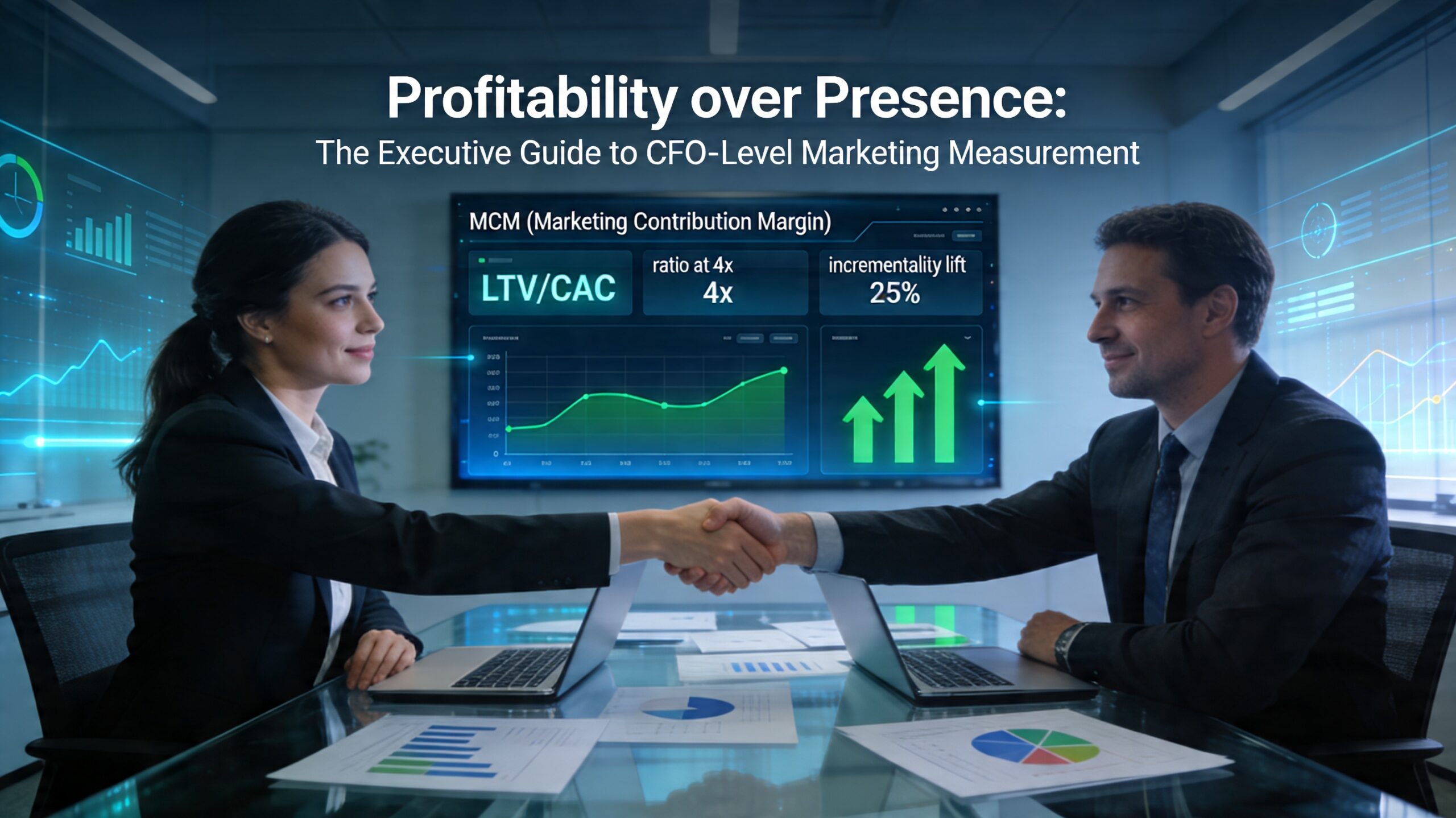
For too long, marketing has been viewed by finance departments as a “cost center” rather than a primary driver of enterprise value. In the 2026 landscape, this disconnect is no longer sustainable. To secure your budget and scale your brand, you must transition from tracking vanity metrics like likes and impressions to measuring marketing output through a financial lens. This isn’t just about reporting numbers; it is about building a high-level analytics framework that speaks the language of the C-suite. By adopting a CFO’s mindset, you ensure that every dollar allocated to your digital strategy is a deliberate investment in the company’s bottom line, setting the stage for a partnership-led growth model.
Transitioning to Marketing Contribution Margin (MCM)
Beyond ROAS to True Profitability: While Return on Ad Spend (ROAS) is a useful tactical metric, it often hides the reality of a campaign’s profitability. A CFO doesn’t care if you turned $1 into $4 if your shipping, fulfillment, and product costs left you with a net loss. We must move toward tracking Marketing Contribution Margin (MCM), which calculates revenue minus variable product costs and marketing spend. This provides a clear picture of how much actual cash marketing is contributing to the business’s fixed costs and operating profit. In our experience, brands that prioritize MCM over ROAS make much smarter scaling decisions because they aren’t blinded by high-revenue, low-profit products that drain the company’s resources.
Accounting for Variable Overheads: To track ROI like a CFO, your analytics must account for the “true” cost of a conversion. This means integrating data points such as credit card processing fees, returns and allowances, and variable shipping costs into your marketing dashboards. By subtracting these from your gross revenue at the transaction level, you can identify which campaigns are driving “quality” revenue versus those that are simply moving inventory at a loss. Priority should be placed on building automated data pipelines that pull these financial figures from your ERP into your marketing analytics platform, ensuring that your performance reports reflect the financial reality of the business.
The Strategic Pivot to Net Profit: Once you have a clear view of your contribution margin, you can begin to optimize for net profit rather than just volume. This might mean pulling back spend on certain “hero” products that have high acquisition costs but low margins, even if they look great on a Google Ads dashboard. We focus on finding the “sweet spot” where your marginal cost of acquisition meets your marginal profit. This high-level financial alignment ensures that your marketing strategy is always moving the needle on the company’s valuation, making you an indispensable partner to the finance team.
Establishing a Multi-Touch Attribution (MTA) Framework
Solving for the Fragmented Customer Journey: In a world of privacy restrictions and cross-device browsing, a simple “last-click” attribution model is a liability. It overvalues bottom-funnel channels like branded search while ignoring the top-of-funnel efforts that actually introduced the customer to your brand. We must implement a Multi-Touch Attribution (MTA) framework that assigns value to every interaction along the path to purchase. This provides a more accurate roadmap of how your social, video, and search efforts work together to drive a final conversion. Without this holistic view, you risk cutting the “assist” channels that are vital for filling your funnel, leading to a slow decline in overall performance.
Data-Driven vs. Rule-Based Models: We focus on moving away from rigid, rule-based models like “First-Click” or “Linear” and toward data-driven attribution that uses machine learning to assign weight to each touchpoint. This model analyzes your account’s unique historical data to determine which interactions are most likely to lead to a sale. By feeding this more accurate attribution data back into your automated bidding strategies, you allow the AI to optimize for the true value of every click. In our experience, transitioning to a data-driven model often reveals that “awareness” channels are significantly more cost-effective than they appear under traditional measurement methods.
Bridging the Offline and Online Gap: For businesses with a physical presence or a high-touch sales cycle, attribution must extend beyond the digital realm. We use advanced tracking methods, such as unique promo codes, store-visit conversions, and CRM integrations, to close the loop on offline sales driven by digital marketing. This “O2O” (Online-to-Offline) visibility is essential for tracking ROI like a CFO, as it accounts for the total business impact of your marketing spend. It ensures that your reporting is comprehensive and that your strategy isn’t being penalized for driving high-value traffic that chooses to convert through a non-digital channel.
Customer Lifetime Value (LTV) and Cohort Analysis
Prioritizing Long-Term Equity Over Short-Term Wins: A CFO views the business through the lens of long-term sustainability, and your marketing analytics should do the same. We must move beyond the “one-and-done” transaction mindset and focus on Customer Lifetime Value (LTV). By tracking how much a customer spends over six, twelve, or twenty-four months, we can determine a more accurate “Maximum CAC” (Cost Per Acquisition). If you know a customer will purchase four times a year, you can afford to spend more to acquire them today. This long-term perspective allows us to be more aggressive in competitive auctions where our competitors are limited by their focus on immediate ROI.
The Utility of Cohort Analysis: We use cohort analysis to track how different groups of customers behave over time based on when or how they were acquired. This helps identify which marketing channels or creative hooks lead to the most loyal, high-value customers. For example, you might find that customers acquired through a “brand story” video have a 30% higher retention rate than those acquired through a “discount” ad. In our experience, these insights are where the real growth happens, as they allow us to stop chasing low-quality traffic and start building a high-value customer base that compounds over time.
Predictive LTV Modeling: In 2026, we don’t just look at past behavior; we use predictive analytics to estimate a customer’s future value from their very first interaction. By analyzing early signals like product category, initial spend, and geographic location, we can assign a “Predicted LTV” to new leads. This allows us to adjust our bidding in real-time, spending more on users who show the hallmarks of a high-value customer. This predictive approach turns your marketing into a precision instrument, ensuring that your budget is always being “invested” in the most promising future assets for the company.
Incrementality Testing and Marketing Mix Modeling (MMM)
Determining the True Impact of Spend: One of the hardest questions a CFO will ask is: “Would these sales have happened anyway?” To answer this with certainty, we must utilize incrementality testing (Lift Studies). This involves running “hold-out” tests where a portion of your audience is intentionally not shown ads, allowing us to measure the “lift” that marketing actually provides over your organic baseline. This removes the fluff from your ROI reporting and proves the true incremental value of your spend. It is the gold standard for proving that your marketing is a revenue generator, not just a bystander to existing demand.
Marketing Mix Modeling (MMM) for Holistic Planning: As privacy changes make individual tracking harder, we look to Marketing Mix Modeling (MMM) to understand the relationship between our total spend and total sales. MMM uses statistical analysis to determine how much each channel, both digital and traditional, contributes to your overall revenue. This high-level view is perfect for C-suite conversations because it accounts for external factors like seasonality, economic shifts, and competitor activity. It provides a strategic macro-view that tells us how to allocate our annual budget across the entire marketing ecosystem for maximum total growth.
Eliminating “Double-Counting” and Waste: A common mistake in marketing reporting is “double-counting,” where both Meta and Google take credit for the same sale. We use a “Single Source of Truth” dashboard to deduplicate these conversions and provide a realistic view of your total ROI. By identifying where different channels are overlapping or cannibalizing each other, we can trim the fat from your budget and reinvest it in areas that drive unique growth. This level of financial rigor is exactly what a CFO looks for, as it demonstrates that you are as concerned with cost efficiency as you are with top-line revenue.
MarTech Integration and Real-Time Dashboarding
Consolidating the Data Silos: You cannot track ROI like a CFO if your data is scattered across five different platforms that don’t talk to each other. We focus on building a centralized data warehouse (like BigQuery or Snowflake) that pulls in data from your ad platforms, your CRM, and your financial software. This “centralized truth” ensures that everyone in the organization is looking at the same numbers and that your marketing reports are always grounded in verified business data. Integration is the foundation of transparency, and transparency is the foundation of executive trust.
Executive-Level Real-Time Dashboards: We replace static, monthly PDFs with dynamic, real-time dashboards that provide an at-a-glance view of your core financial KPIs. These dashboards should be structured to show high-level trends, such as “Profit per Acquisition” and “Total Contribution Margin”, while allowing for deep dives into specific campaigns. By providing the C-suite with a clear, visual representation of marketing’s impact on the business, you eliminate the “black box” perception of marketing and move toward a more data-driven, collaborative relationship.
Automated Anomaly Detection and Alerts: To maintain high-level efficiency, we implement automated alerts that notify us the moment a core KPI deviates from its expected range. Whether it’s a sudden spike in CAC or a drop in site-wide conversion rate, these alerts allow us to pivot and protect your ROI before it impacts your quarterly targets. This proactive approach to data management mirrors the financial controls a CFO uses to manage the company’s capital. It demonstrates that you have your finger on the pulse of the business and are ready to act the moment the data suggests a change is needed.
Summing It Up
Tracking ROI like a CFO is the only way to build a sustainable, scalable marketing engine in 2026. By moving beyond vanity metrics and embracing contribution margins, LTV, and incrementality, you turn your marketing efforts into a high-performance investment portfolio. This level of financial accountability doesn’t just protect your budget as it elevates your role within the organization from a tactical executor to a strategic growth partner. We don’t want to just “spend” money; we want to deploy capital in a way that creates lasting enterprise value.
Are you ready to bring financial rigor to your marketing strategy? Let’s connect to build your CFO-ready analytics roadmap today.

Maximizing Growth: The Executive Roadmap for 2026

Revenue-Driven Content: The Strategic Blueprint for Scalable Conversions

AI Search and GEO: The Complete Guide to Ranking in the Age of Generative Search
Get the latest digital marketing insights, strategies, and industry trends delivered directly to your inbox.
Weekly insights
No spam
Unsubscribe anytime
Join 10,000+ marketers who trust eMarketLift for cutting-edge digital marketing insights.